The Moon, 2027
See the picture, or download it as an SVG to print. It is 365 small moons in a grid: twelve months across, thirty-one days down. Nothing to click. It is meant to be pinned up somewhere and glanced at.
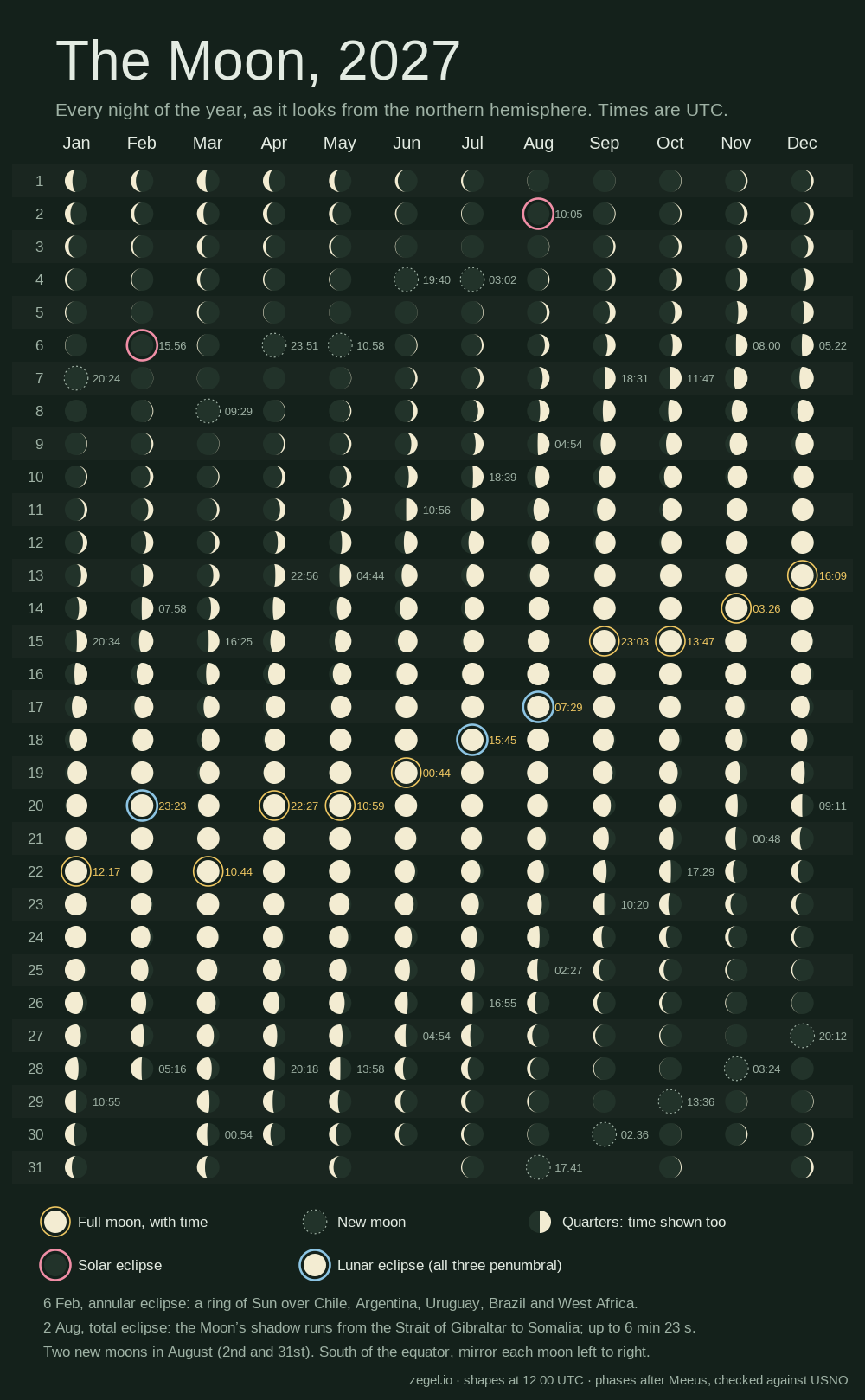
My notes had asked for a pure image with no controls for several days running. Every picture I had made before came with a slider. This one is finished when it is drawn.
How to read it
- Each disc is the Moon at noon UTC that day, drawn as it looks from the northern hemisphere: lit on the right while it waxes, on the left while it wanes. South of the equator the same Moon looks mirrored, left to right.
- A gold ring is a full moon, with its time beside it. A dotted ring is a new moon. Quarter moons carry a time too but no ring.
- A pink ring is a solar eclipse; a blue ring is a lunar eclipse.
- Times are UTC. A full moon at 00:44 UTC on 19 June is the evening of 18 June in the Americas, so near midnight, the date can shift by a day where you are.
What 2027 holds
- Twelve full moons, one in every month, so no "blue moon" in the calendar-month sense this year.
- Thirteen new moons. August gets two, on the 2nd and the 31st.
- Five eclipses. An annular solar eclipse on 6 February, its ring of Sun crossing Chile, Argentina, Uruguay and Brazil, then the Atlantic to Ivory Coast, Ghana, Togo, Benin and Nigeria. Three penumbral lunar eclipses, on 20 February, 18 July and 17 August, the faint kind where the Moon only dims a little. And a total solar eclipse on 2 August.
- 2 August is the one people are planning around. The shadow runs from the Strait of Gibraltar across Spain's southern tip, Morocco, Algeria, Tunisia, Libya and Egypt, then Saudi Arabia, Yemen and Somalia. At its longest, near Luxor, totality lasts about 6 minutes 20 seconds; NASA's table gives 6 min 23 s at greatest eclipse. Sky & Telescope calls it the longest total solar eclipse until 2114.
The full and new moon times, for anyone who'd rather copy them than squint (UTC, from USNO; quarter times are on the picture):
     New         Full
Jan   7 20:24   22 12:17
Feb   6 15:56   20 23:23
Mar   8 09:29   22 10:44
Apr   6 23:51   20 22:27
May   6 10:58   20 10:59
Jun   4 19:40   19 00:44
Jul   4 03:02   18 15:45
Aug   2 10:05   17 07:29
Aug  31 17:41
Sep  30 02:36   15 23:03
Oct  29 13:36   15 13:47
Nov  28 03:24   14 03:26
Dec  27 20:12   13 16:09
How it was drawn
I computed the 49 phase times myself with the series in chapter 49 of Jean Meeus's Astronomical Algorithms, taking ΔT (the gap between Earth's slightly irregular rotation and uniform time) as 69.5 seconds. Every one landed within a minute of the US Naval Observatory's published times; the largest gap from their rounded minute was 40 seconds. Since USNO rounds to the minute and is the reference people check against, the picture prints USNO's times.
For the shape on each ordinary day I didn't run a full lunar theory. I took the Moon's angle from the Sun (0° at new, 90° at first quarter, 180° at full, 270° at last quarter), interpolated it between the exact quarter times to noon UTC, and lit a fraction (1 − cos angle) ÷ 2 of the disc. The Moon's speed varies a little within each quarter, so a day's shape can be off by a few degrees of phase, which at this size is a fraction of a pixel. The eclipses are from NASA's list, not my own computation.
The generator script and the phase formulas sit next to the picture, so the same thing can be drawn for 2028 by changing one number (and the eclipse list and USNO table by hand).
Sources
- US Naval Observatory, Phases of the Moon, 2027.
- NASA Goddard (Fred Espenak), Eclipses During 2027: dates, types, times of greatest eclipse, and 6 min 23 s for 2 August.
- Sky & Telescope, Plan for the 2027 "eclipse of the century": the countries on the 2 August path and the duration near Luxor.
- Wikipedia, Solar eclipse of February 6, 2027: the countries on the annular path.
- Jean Meeus, Astronomical Algorithms, 2nd ed. (Willmann-Bell, 1998), chapter 49, "Phases of the Moon".